


Remuneration
Remuneration
Main revisions to the executive Remuneration systemMain Revisions to the Remuneration System for Executive Officers
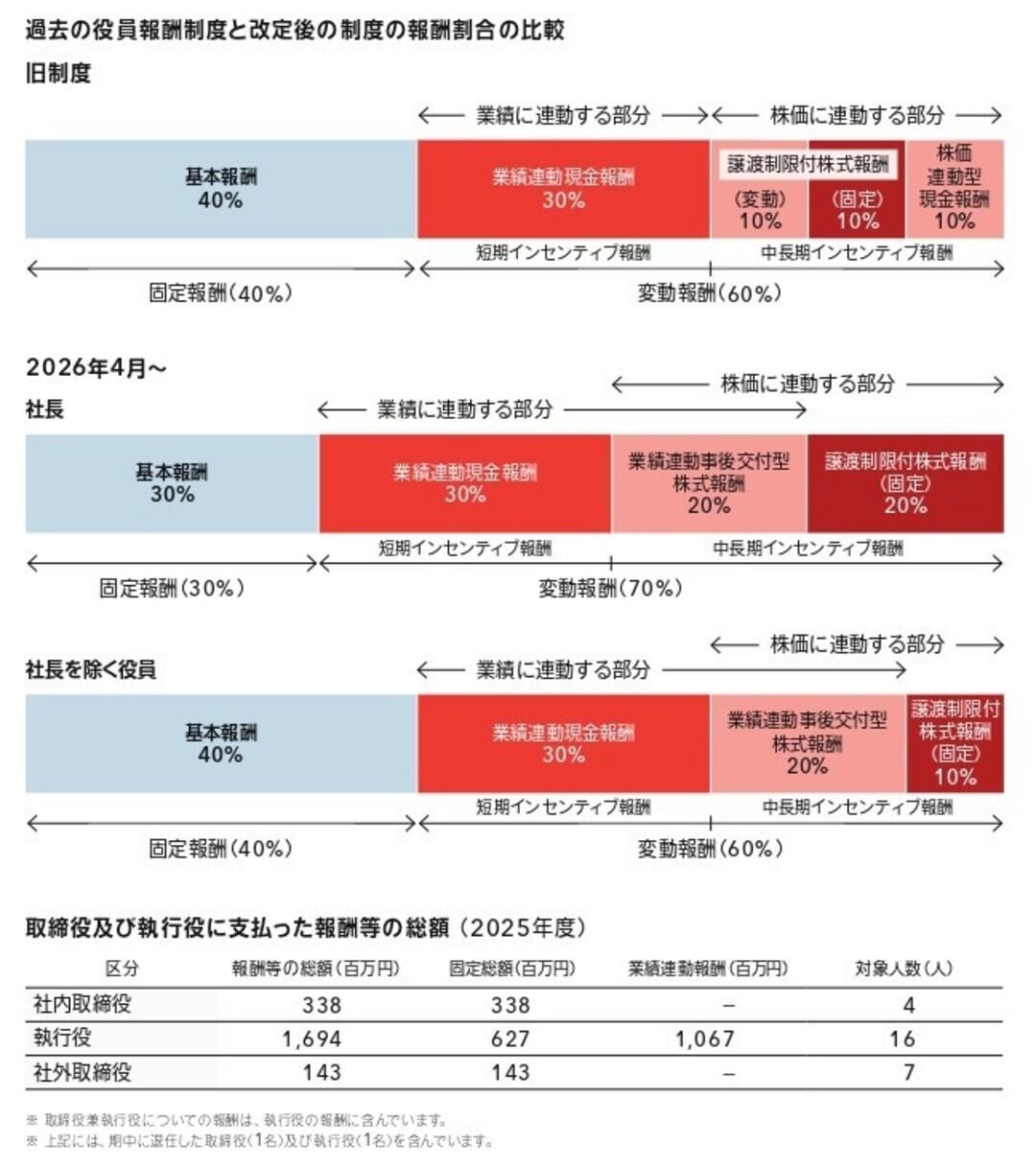
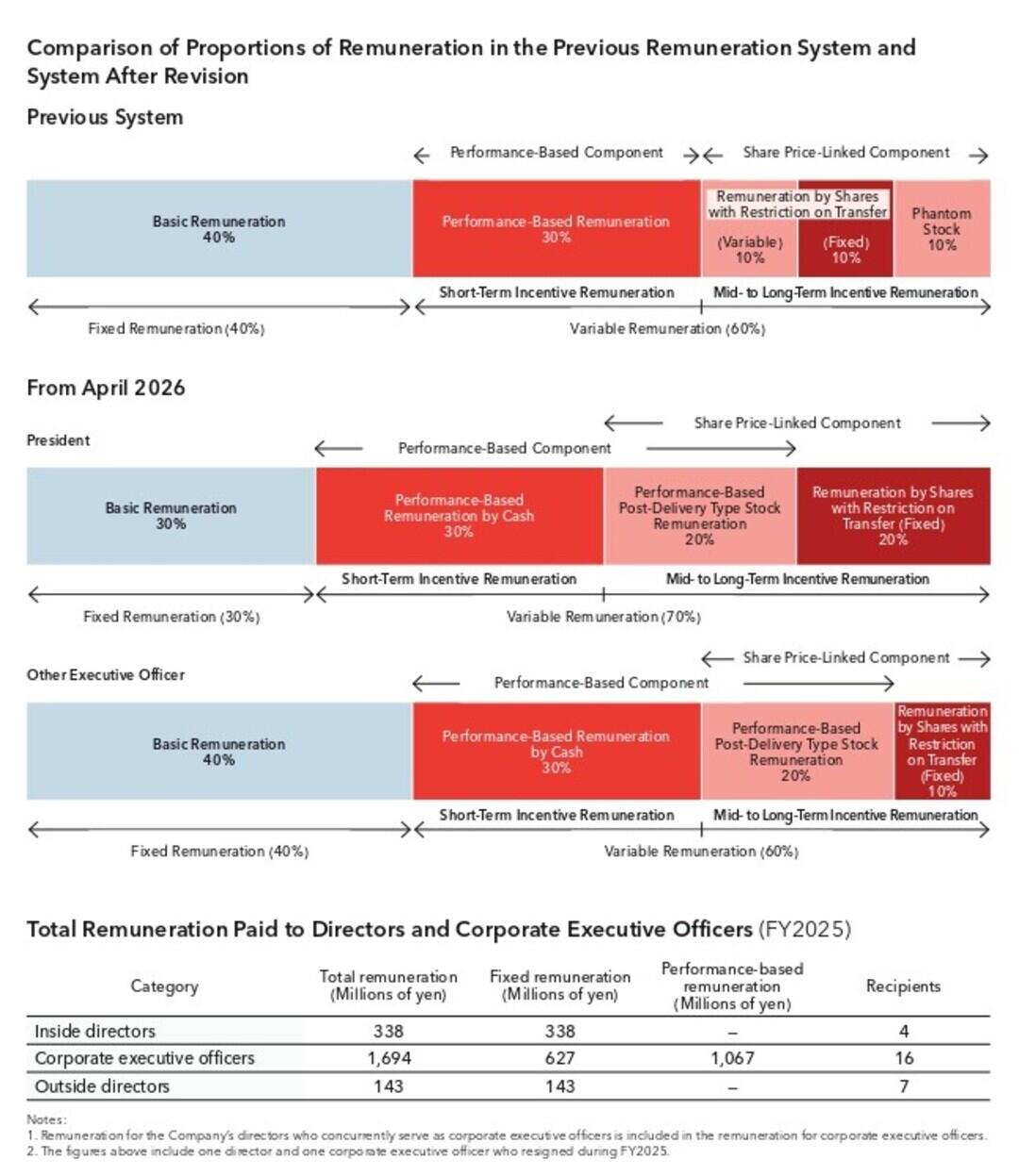
① Introduction of a performance-linked post-payment stock Remuneration system and adoption of ESG indicators.
We have introduced a performance-linked post-payment stock Remuneration system (a compensation system in which a performance evaluation period and performance evaluation indicators are set in advance, and stocks are paid after the evaluation period has elapsed according to the degree of achievement of those evaluation indicators; Performance Share Units; hereinafter referred to as PSUs) to provide stronger Remuneration for achieving medium- to long-term goals. As performance evaluation indicators for PSUs, in addition to financial indicators, we have adopted company-wide ESG indicators common to executive officers, executive directors, and group executive directors. With the introduction of PSUs, the variable portions of the stock price-linked cash Remuneration and restricted stock Remuneration paid under the current system have been abolished (the fixed portion of restricted stock Remuneration will continue).
② Changes in the composition ratio of President & Chief Executive Officer Remuneration
To better incentivize top management to pursue long-term business plans and enhance corporate value beyond that, we have changed the proportion of variable Remuneration in President & Chief Executive Officer Remuneration to 70% of the total (currently 60%).
The revised policy is as follows:
(1) Introducing a Performance-Based Post-Delivery-Type Stock Remuneration Plan and Adopting ESG Indicators
To create a stronger incentive to achieve medium- to long-term targets, the Company has introduced a performance-based post-delivery-type stock remuneration plan (Performance Share Units [hereinafter “PSUs”]). This is a remuneration system in which the performance evaluation period and the performance evaluation indicators are set in advance and shares, etc., are granted after the evaluation period in accordance with the degree of achievement of the evaluation indicators. In addition to financial indicators, company-wide ESG indicators common to the Representative Corporate Executive Officers, Senior Executive Officers, Executive Officers and Group Executive Officers are employed in the evaluation. In conjunction with the introduction of PSUs, the phantom stock remuneration and the variable component of the remuneration by shares with restriction on transfer granted under the current system were discontinued, while the fixed component of the remuneration is continued.
(2) Changing Composition of Remuneration for the President
In order to create a stronger incentive for top management to enhance corporate value with reference to the long-term management plan and beyond, the proportion of variable remuneration for the President was changed to 70% of the total (currently 60%).
In connection with this revision, provisions were established relating to ownership of the Company shares by its executive officers and provisions requiring the return of executive remuneration in the event that misconduct, etc. by an executive officer is confirmed (malus and clawback provisions) in the Policy on Determining Amounts of Executive Remuneration established by the Remuneration Committee.
The policy after revision is as on the right.
Policy on Determining Amounts of Executive Remuneration, etc.Policy Concerning Decisions on the Details of Remuneration, etc. for each Director and Corporate Executive Officer
① Procedures for determining executive Remuneration(i)Procedures for Deciding Remuneration Paid to Officers
The policies regarding the determination of Remuneration for our Director and executive officers, as well as the details of individual Remuneration, will be decided by a resolution of Remuneration Committee which is composed solely of outside Director.
The policy concerning decisions on the details of remuneration paid to Directors and Corporate Executive Officers of the Company and the details of remuneration for each person shall be decided upon by a resolution at the Remuneration Committee, which is comprised solely Outside Directors.
② Basic policy for determining executive Remuneration(ii)The basic policy for deciding remuneration for Officers
The basic policy for determining Remuneration of our Director and executive officers is as follows:
The basic policy for deciding remuneration for Directors and Corporate Executive Officers of the Company is as follows.
- Remuneration system will be linked to the medium- to long-term performance targets outlined in the management strategy and medium- to long-term management plan, thereby achieving sustainable corporate value enhancement and value sharing with shareholders.
- Remuneration system will be designed to provide incentives that encourage management to take on challenges and take appropriate risks, in line with strategic objectives and the expectations of stakeholders, including shareholders.
- Through objective deliberations and judgments by Remuneration Committee, we will establish a Remuneration system that enables us to fulfill a high degree of accountability to our shareholders and other stakeholders.
- The remuneration system shall be the one that is linked with our medium- to long-term performance targets, etc., aimed at in the management strategy and the Medium-to Long Term Management Plan and realizes sustained corporate value improvement and sharing of values with our shareholders.
- The remuneration system shall be the one that allows for giving incentives to management executives' taking up of challenges and appropriate risk-taking in line with the strategy targets and expectations of shareholders and other stakeholders.
- The remuneration system shall be the one that makes it possible to fulfill the high accountability for the benefit of our shareholders and other stakeholders through objective deliberations and judgments at the Remuneration Committee.
③ Executive Remuneration system(iii)Remuneration Systems for Officers
Remuneration systems for Director and executive officers will be separate, taking into account the respective functions and roles they should fulfill to ensure sustainable corporate value enhancement. Director also serve as executive officers will receive Remuneration for their executive officer duties.
The remuneration systems for Directors and Corporate Executive Officers shall be separately established in consideration of their respective functions and roles to be fulfilled for the purpose of achieving sustained corporate value improvement. In addition, Directors who concurrently serve as Corporate Executive Officers shall be paid remuneration as Corporate Executive Officers.
- Director (excluding Director concurrently serving as executive officers)
In light of the function and role of supervising the execution of duties by Executive Officers and Director, as a general rule, only basic Remuneration is in the form of money, and the level of remuneration will be determined individually taking into account the position and responsibilities as Director, whether full-time or part-time, etc. and decide. - executive officer
In light of the function and role of being responsible for the execution of our business, compensation will, in principle, consist of a base Remuneration and variable Remuneration. Variable Remuneration will consist of monetary Remuneration paid based on short-term performance, etc., and stock Remuneration (restricted stock Remuneration and performance-linked post-grant stock Remuneration paid based on medium- to long-term performance, etc.) paid with the aim of realizing value sharing with shareholders in the medium to long term.
The level and ratio of base Remuneration and variable Remuneration, as well as the evaluation indicators for variable Remuneration, will be determined taking into consideration the management strategy, the medium- to long-term performance targets outlined in the medium- to long-term management plan, and the executive officer's position and responsibilities. -
Directors (excluding Directors who concurrently serve as Corporate Executive Officers)
In consideration of their function and role of supervising performance of duties by Corporate Executive Officers and Directors, they shall receive, in principle, only basic remuneration in the form of money, and the standards shall be decided upon individually taking into account factors such as position and responsibilities as Directors and whether they are full-time or part-time. -
Corporate Executive Officers
In consideration of their function and role of taking charge of business execution of the Company, their remuneration shall, in principle, be comprised of basic remuneration and variable remuneration. Variable remuneration is comprised of monetary compensation that is paid based on short-term performance, etc., and stock remuneration, etc. (including restricted stock remuneration and Performance-based post-delivery-type stock remuneration (Performance Share Units) that is paid based on medium- to long-term performance, etc.) that is paid with a view to realizing the medium- to long- term sharing value with shareholders.
The standards and ratios of basic remuneration and variable remuneration, valuation indicators for variable remuneration, and other matters shall be decided upon taking into account medium- to long-term performance targets, etc., aimed at in management strategies and the Medium- to Long- Term Management Plan and factors such as position and responsibilities as Corporate Executive Officers.
④ Basic policy regarding the holding of company shares(iv)Basic Policy on Shareholding of the Company’s Shares
Our company requires that Director and executive officers hold shares granted by the company as compensation, in the form of shares equivalent to at least four times their annual base Remuneration for the President and President & Chief Executive Officer (and at least 1.5 times their annual base Remuneration for other executive officers), with the aim of sharing Remuneration with shareholders. Furthermore, during their term of office, the officers concerned shall continue to hold and not sell such shares until they reach the aforementioned number of shares.
The Company shall require Directors and Corporate Executive Officers to hold shares of the Company granted as remuneration for the purpose of sharing value with shareholders. Specifically, the President and Chief Executive Officer shall hold shares equivalent to at least four times the amount of their annual basic remuneration, and other Corporate Executive Officers shall hold shares equivalent to at least 1.5 times the amount of their annual basic remuneration. Eligible Officers shall retain such shares and shall not sell them until the above shareholding level has been achieved during their term of office.
⑤ Introduction of the Mars clause and the Clawback clause(v)Introduction of Malus and Clawback Provisions
To ensure sound governance and promote accountability and ethical conduct in business operations, our company will introduce Mars and Clawback clauses into its executive Remuneration system. If misconduct by Director or executive officer covered by these clauses, or if a restatement of financial statements is discovered, Remuneration Committee may, through deliberation and resolution, take the following actions.
The Company shall introduce malus provisions and clawback provisions in its remuneration system for Officers for the purpose of ensuring sound governance and promoting accountability and ethical conduct in business execution. In the event that misconduct by Directors or Corporate Executive Officers subject to such provisions or restatement of financial statements is identified, the following measures may be taken based on deliberation and resolution by the Remuneration Committee:
- Under the Mars clause, the granting and payment Remuneration before vesting will be revoked.
- Under the clawback clause, the company may request the return of Remuneration already granted or paid, taking into account the severity of the circumstances that arose, for up to three years Remuneration.
- Under malus provisions, the grant or payment of remuneration prior to vesting may be cancelled.
- Under clawback provisions, taking into account the materiality of the relevant event, the Company may require the return of remuneration already granted or paid, retroactively for up to three years.
(1) Performance-linked cash Remuneration(1) Performance-Based Monetary Compensation
- Remuneration type: Money
- Performance evaluation period: 1 year
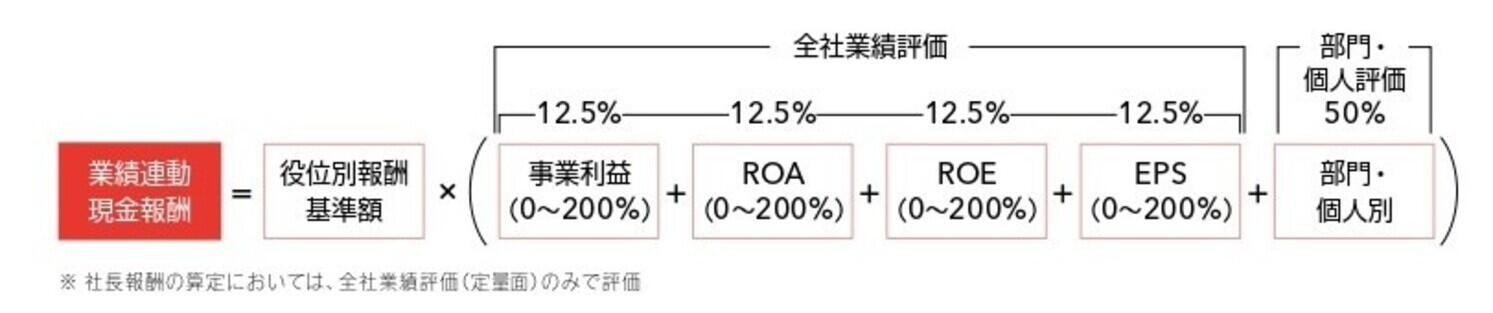
- Remuneration determination method and main evaluation items: Compensation is determined based on quantitative aspects such as the previous year's performance of each indicator, using target levels for company-wide operating profit, ROA, ROE, EPS, and the operating profit of the department each executive is responsible for as a basis. In addition, for departmental and individual evaluations, qualitative aspects such as the degree of contribution to medium- to long-term performance, as assessed through interviews President & Chief Executive Officer are also taken into consideration.
- Form of remuneration: Cash
- Performance evaluation period: One year
-
Payout calculation and major evaluation items:
The payout amount is determined based on the previous fiscal year’s performance and other quantitative factors for each indicator (e.g., overall business profit, ROA, ROE, EPS, and business profit in the divisions for which the individual officers are responsible) compared with their target level. In addition, in division and individual evaluations, qualitative factors are also considered in the evaluation, such as the degree of contribution to performance over the medium to long term as assessed during interviews with the president.

(2) Performance-linked stock Remuneration (PSU Remuneration)(2)Performance-Based Post-Delivery Type Stock Remuneration (PSUs)
- Remuneration type: Stocks and cash
- Performance evaluation period: 3 years
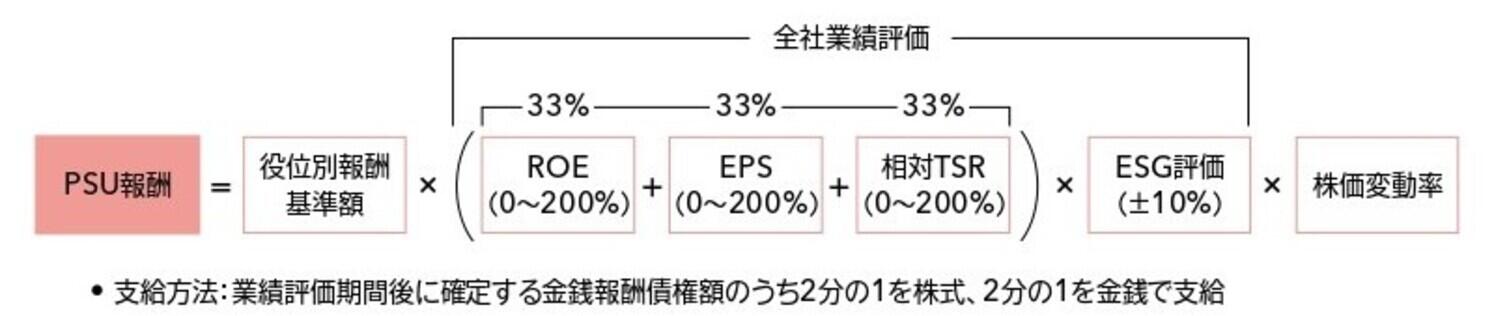
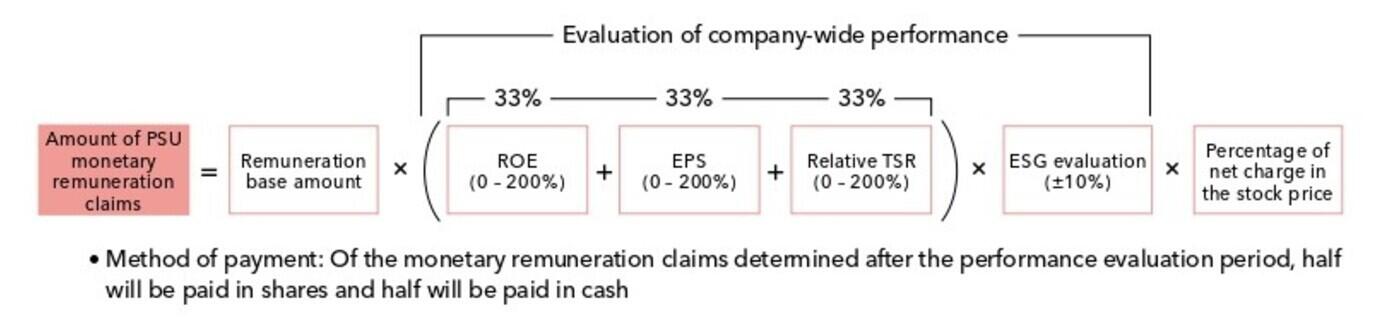
- Method of determining Remuneration and main evaluation criteria: The amount of monetary Remuneration claim is determined by multiplying the standard Remuneration amount set for each position by (i), (ii), and (iii) below.
(i) Percentage change (range of change: 0% to 200%) according to the degree of achievement of our financial indicators (ROE:EPS:Relative TSR = 1:1:1) during the performance evaluation period.
* Relative TSR is a percentage change (with a range of 0% to 200%) based on the relative ranking of total shareholder returns among six companies, including five competitors, during the performance evaluation period.
Other companies in the same industry include Nomura Real Estate Holdings, Inc., Tokyu Fudosan Holdings, Inc., Mitsui Fudosan Co., Ltd., Tokyo Tatemono Co., Ltd., and Sumitomo Realty & Development Co., Ltd.
(ii) Percentage of change (with a range of ±10%) in accordance with the degree of achievement of ESG indicators that evaluate the company's efforts to enhance social value during the performance evaluation period.
* Regarding ESG indicators, quantitative indicators such as the reduction rate of GHG emissions per unit and employee engagement scores have been established as indicators to evaluate efforts related to "addressing social issues through business activities," "promoting GHG emission reduction," and "promoting DE&I and creating a vibrant workplace," and all executives will use the same indicators.
(iii) Percentage change in the share price of our common stock during the performance evaluation period - Form of remuneration: Shares and cash
- Performance evaluation period: Three years
-
Payout calculation and major evaluation items: The payout amount of monetary remuneration claims will be determined by multiplying each officer's base amount by factors (i), (ii), and (iii) described below.
(ⅰ)A variable percentage (ranging from 0% to 200%) corresponding to the degree of achievement of the Company's financial indicators (ROE : EPS : Relative TSR = 1 : 1 : 1) during the performance evaluation period
* For relative TSR, a variable percentage (ranging from 0% to 200%) corresponding to the relative ranking of total shareholder return among six companies, including five peer companies, during the performance evaluation period
Five peer companies: Nomura Real Estate Holdings, Inc., Tokyu Fudosan Holdings Corporation, Mitsui Fudosan Co., Ltd., Tokyo Tatemono Co., Ltd., and Sumitomo Realty & Development Co., Ltd.
(ⅱ)A variable percentage (range of variation ±10%) corresponding to the degree of achievement of ESG indicators that evaluate initiatives contributing to enhancing the Company's social value during the performance evaluation period
* For ESG indicators, quantitative indicators (e.g., reduction in GHG emissions intensity, employee engagement score) common to all executives have been established to evaluate initiatives in the following areas: "efforts to solve social issues through business activities," "promotion of GHG emission reductions," and "promotion of DE&I and creation of a vibrant workplace."
(ⅲ)Percentage of net change in the Company's common stock price for the performance evaluation period
(3) Restricted stock Remuneration (fixed)(3)Remuneration by Shares with Restriction on Transfer (Fixed)
- Remuneration structure: Stock
* Shares equivalent to the monetary Remuneration claim amount according to Remuneration standard amount for each position will be provided. - Transfer restriction period: Until the director (including non-executive Director) resigns.
-
Form of remuneration: Shares
* Shares are granted for the amount of monetary remuneration claims corresponding to each officer’s base amount of remuneration. - Transfer restriction period: Until resignation as an officer (includes non-executive directors)